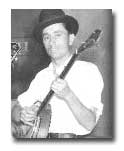
Born July 3,
1893, in Teoc, Mississippi, Hurt and his family moved
in 1895 to Avalon, a town on the edge of Mississippi's
hill country. He dropped out of school at the age of
nine to begin working as a farmer. In 1902, Hurt
picked up the guitar, a $1.50 "Black Annie" his mother
bought him. Self-taught, Hurt developed a distinctive
three-finger style that bears no resemblance to other
area musicians. He also developed proficiency with the
harmonica but was always a self-accompanied musician.
Unlike Furry Lewis and Memphis Minnie, Hurt refused an
offer to accompany a traveling medicine show,
preferring to stay close to home.
Hurt played solo at
local parties where his fluid yet highly syncopated
guitar style made him a favorite among Carroll
County dancers. His fame was localized, however; it
was not until 1912 that he started playing parties
around Jackson, Mississippi, 103 miles from his
native Avalon. While Hurt worked mostly outside
music as a farmer and laborer, his musical
reputation among whites as well as blacks led to his
first recording session in Memphis in 1928. Willie
T. Narmour and Shell W. Smith, two white country
musicians from Carroll County, recommended him to
their record producer, Tommy Rockwell.
Hurt recorded eight
sides for the Okeh label, two of which were released
and sold well: "Frankie" and "Nobody's Dirty
Business." In Memphis for the same recording session
was St. Louis guitarist/pianist Lonnie Johnson, and
Hurt later recalled that Blind Lemon Jefferson and
Bessie Smith were also in town. He saw none of these
famous musicians play but instead returned home to
Avalon. Okeh called Hurt to New York City for
another session in December 1928, where he cut
twelve additional sides, including "Avalon Blues."
Again, Hurt returned home to Avalon to farm and play
music for local parties.
These two sessions were
the extent of Hurt's recording before the Great
Depression curtailed record sales. His graceful
picking, gentle crooning, and homespun lyrics marked
him as an exceptionally talented musician. The
preponderance of songs about legendary figures in
his repertoire ("Casey Jones," "Frankie," "Stack
O'Lee Blues") and the lack of then-modern blues
influences on his style, establish Hurt as a link
between the nineteenth and twentieth centuries. Okeh
originally designated two of his songs "Old Time
Music," an appellation reserved for the label's
hillbilly series. This, together with the fact that
white musicians were familiar with and recommended
his musicianship, suggests strongly that Hurt's
music sprang from a common source that produced
blues and country music.
Hurt lived a quiet life
as a farmer and laborer, playing occasional parties
and fish fries until 1963. He was rediscovered in
Avalon, a consequence of having named it as his
hometown in a record made thirty-five years before.
Hurt enjoyed great popularity during the blues
revival of the 1960s, making television appearances,
playing folk festivals, and recording albums.
Exceptionally well liked by all who came in contact
with him, he became the most famous of all the
rediscovered 1920s bluesmen, eclipsing in his fame
the celebrated Son House and Skip James.
His newfound fame lasted
three years before his death on November 2, 1966.
Mississippi John Hurt's grave is located outside his
hometown of Avalon, Mississippi.
By
Sean
Styles
 -
-